

Invited talks
The Invited Talks at IDEAL 2025 bring together experts to share their latest research and practical insights straightforwardly and engagingly. These sessions are an excellent opportunity to explore new ideas, tackle current challenges, and see how cutting-edge techniques are applied in the real world. This year, we are very proud to host the following invited talks:
1. The Next Frontier in Explainable AI: Human-AI Synergy.
As AI systems become more complex, the need for effective explanations grows, especially in contexts where human decision-making is involved. This plenary talk explores the evolving role of explainable AI (XAI) in fostering human-AI collaboration. While traditional approaches to XAI focus on mathematical approaches looking for transparency but dificult for society understanding, the next frontier lies in creating explanations that empower users and end-users better understand AI’s reasoning and AI’s advises and enhance their decision-making capabilities.
We will examine how well-designed explanations can bridge the gap between AI outputs and human comprehension, enabling more informed decisions in critical areas such as healthcare, finance, and autonomous systems. The focus will be on the utility of explanations in making AI more actionable and trustworthy, fostering a symbiotic relationship where humans and AI co-create decisions. By focusing on human-AI synergy, we aim to move beyond simply explaining AI’s behavior to facilitating collaborative decision-making, ensuring that explanations truly serve the needs of users and support effective, ethical decision-making.

Francisco Herrera Triguero
Francisco Herrera received the M.Sc. degree in mathematics in 1988, and the Ph.D. degree in mathematics in 1991, both from the University of Granada, Spain. He is a Professor in the Department of Computer Science and Artificial Intelligence at the University of Granada and Director of the Andalusian Research Institute in Data Science and Computational Intelligence (DaSCI). He’s an Academician in the Royal Academy of Engineering (Spain). He has been the Supervisor over 60 Ph.D. students. He has published more than 600 journal papers, receiving
more than 144 000 citations (Scholar Google, H-index 179). He has been nominated as a Highly Cited Researcher (in the fields of computer science and engineering, respectively, 2014 to present, Clarivate Analytics). He acts as Editorial Member of a dozen of journals. His current research interests include among others, computational intelligence, information fusion and
decision making, trustworthy artificial intelligence and data science (including data preprocessing, prediction and big data).
He is currently considered one of the most influential Spanish scientists in the world in the field of Computer Science and Engineering.
2. Human-Centered NLP for Behavioral Health: From Conversation to Coaching
Conversations shape how we connect, learn, and heal. In behavioral and mental health, the words exchanged between patients and clinicians can profoundly influence outcomes — yet providing clinicians with feedback on how they communicate remains a slow, resource-intensive process. This keynote explores how advances in natural language processing (NLP) can help bridge that gap through AI systems that analyze, evaluate, and coach human conversations in this domain. I will present computational models that automatically assess and coach the acquisition of key counseling behaviors, such as empathy and reflective listening, offering real-time actionable feedback to clinicians and trainees. These systems are based on large language models fine-tuned for psychotherapy contexts and developed in close partnership with clinicians and practitioners. Beyond automating evaluation, they open new possibilities for personalized coaching and scalable communication training. Throughout, I will discuss the broader challenges and opportunities of applying NLP to sensitive human domains — emphasizing transparency, ethics, and the importance of keeping humans at the center. Together, these efforts point toward a future where language technologies do more than process what we say — they help us say it better.
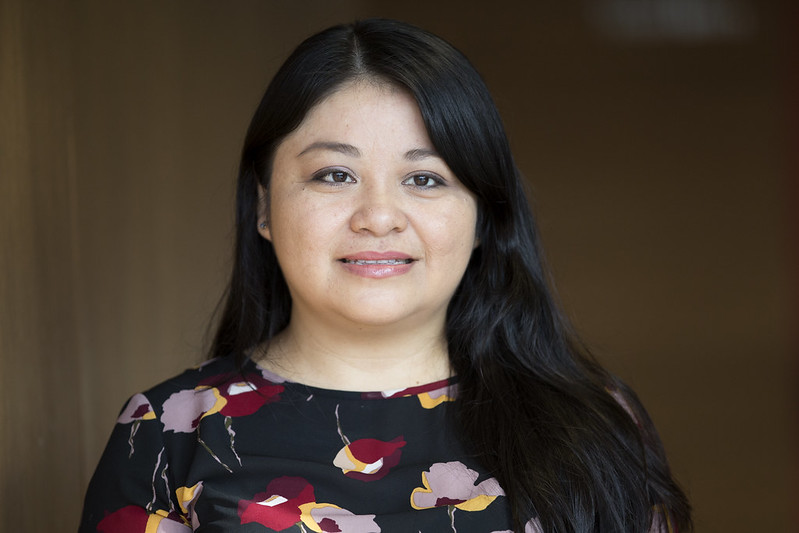
Verónica Perez-Rosas
Veronica Perez-Rosas is an Assistant Professor in the Department of Computer Science at Texas State University. Previously, she was a Research Scientist in the Computer Science and Engineering Department at the University of Michigan. Her research lies at the intersection of natural language processing, machine learning, and behavioral science, focusing on computational methods to analyze and predict human behavior in social and health contexts. She develops language-based models for behavioral and mental health applications, advancing our understanding of empathy, affect, and communication dynamics in clinical and everyday interactions. Dr. Perez-Rosas has authored papers in leading conferences and journals in natural language processing and multimodal analysis and collaborates across computer science, psychology, and public health disciplines. She has mentored numerous graduate and undergraduate researchers and has served as workshop organizer, area chair, and reviewer for major international conferences in AI and NLP. Her research aims to create human-centered AI systems that connect computational advances with real-world social and health impact.